It’s has been just 18 days since I completed ‘The Way of St. Werburgh’ and after a very busy couple of weeks at work, I have managed to find some time to put together a quick video of the journey. It can be found here:
Over this pilgrimage I filmed longer videos and narrated them for a vlog type project, giving a bit more detail for you to experience the joys and challenges that this solo hike entailed. I did them all on my phone, so don’t expect any Spielberg epics.
I’ve never done a vlog before, and playing back some of the footage during my editing is a bit cringe; hopefully if I get the courage to post them, it would at least give you some laughs. It is safe to say, currently, I am a better blogger than a vlogger! I’ll make a post when I’ve built up the confidence to post them.
My blogs are a hobby for me, and in the same spirit as are any vlogs I publish, and I won’t take them too seriously. For now, I hope you enjoy this quick montage of my Two Saints Way.
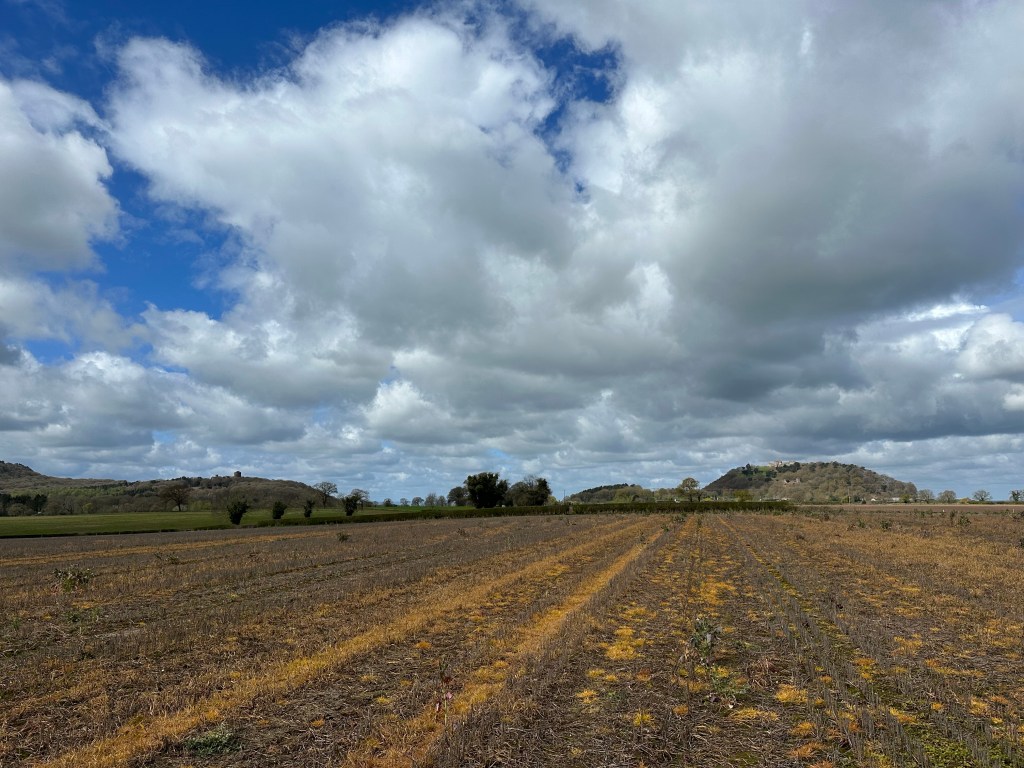
It was the polar opposite to yesterday. The weather played ball, I even caught the sun! The way markers were 99% of the time on par. There was one marker coming out of Bunbury that was on the wrong direction, however it was a dead give away, as it wasn’t pointing to the big hill with a castle on top.
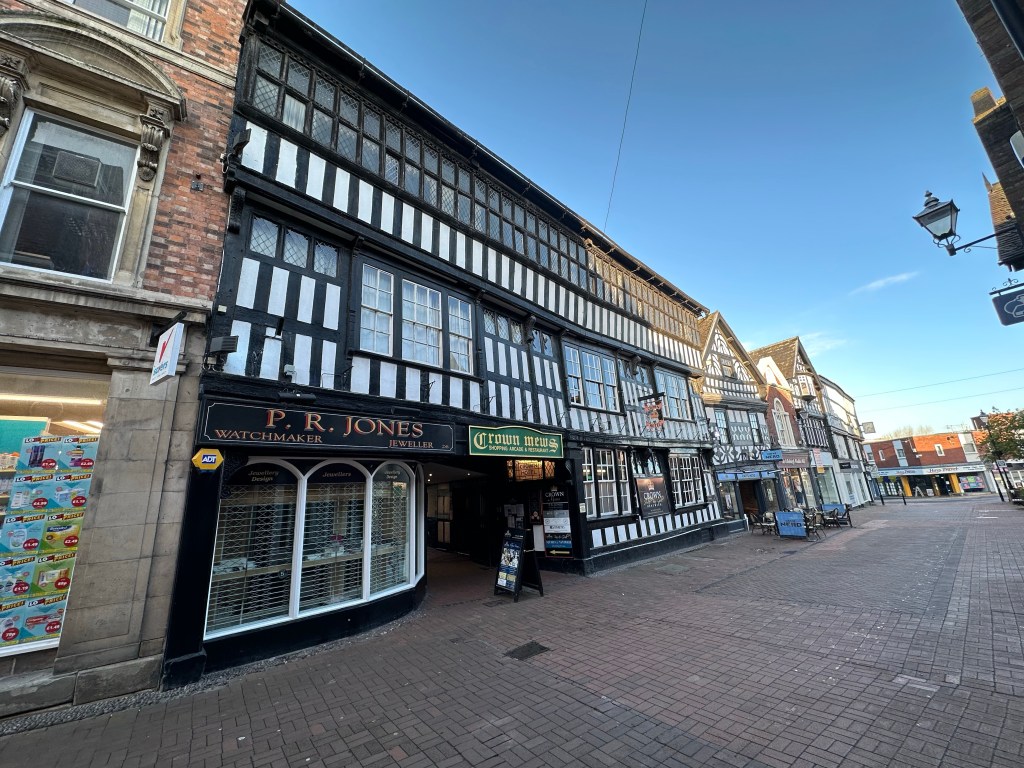
After spending the night in one the most craziest buildings, I was refreshed after the previous day’s antics. The Crown Hotel, doesn’t have a single level surface. The floors all slope, the stairs are crooked, not even the toilet roll holder was straight! What topped it off was the hot water came out the cold tap.
I was in one of the rooms at the top to the left
It’s a very oldie worldie place and it’s all part of its charm. If a building was to be haunted, it would be this one. (Although I didn’t experience any ghostly apparitions, but that could be because I slept like I’d just walked over 40km).
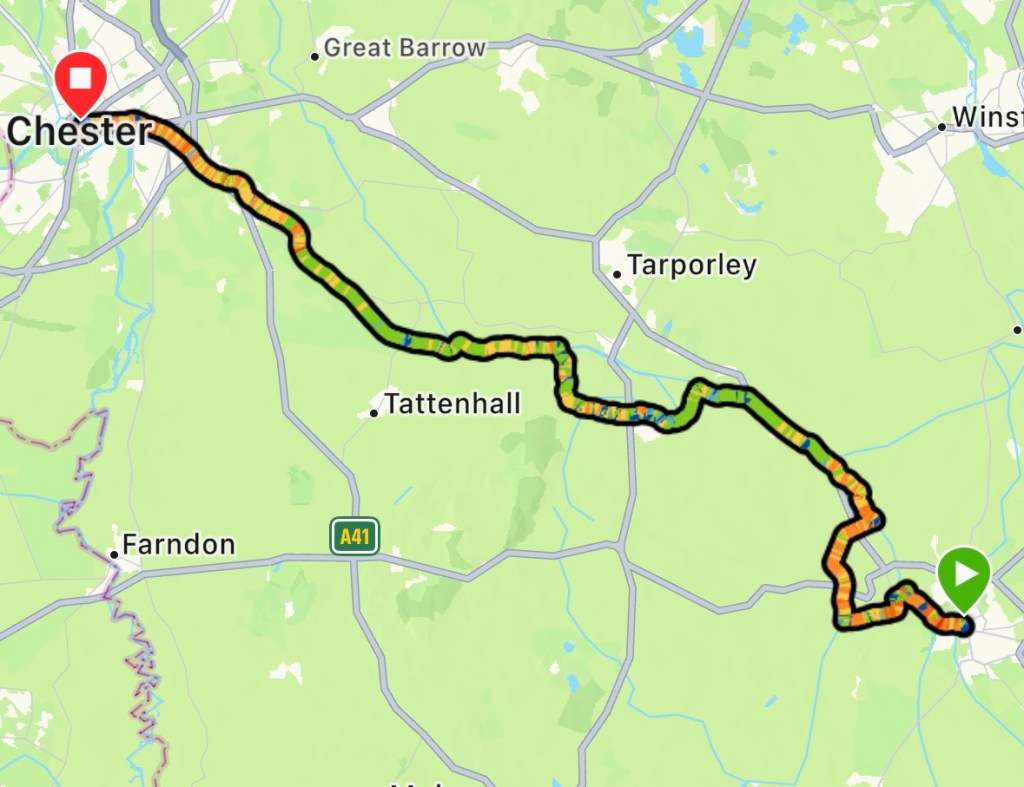
At 7.30am I started my walk to Chester. Once out of Nantwich I joined the Shropshire Union Canal, lapping up the sunshine; although there was a biting wind. At Acton I left the canal to cut across fields to join the Llangollen Canal.
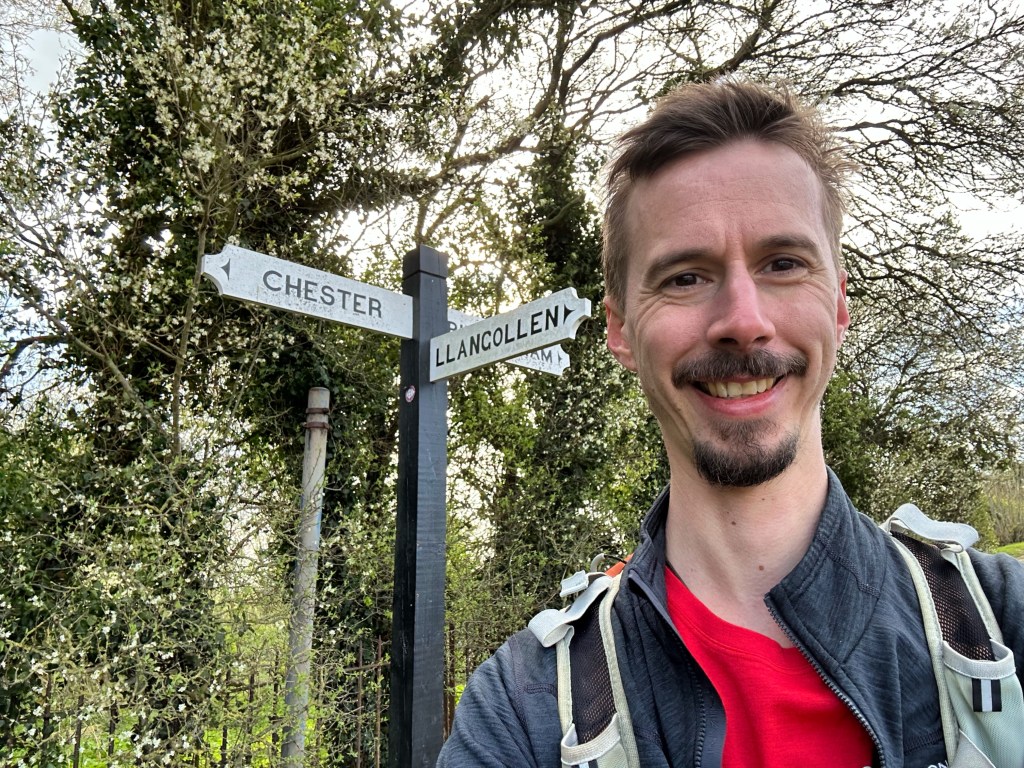
I followed this until it joined the Shropshire canal after a series of steep locks. Finding the sign pointing to Chester, I followed the towpath, pausing once to chat with a fisherman preparing for a competition at the weekend.
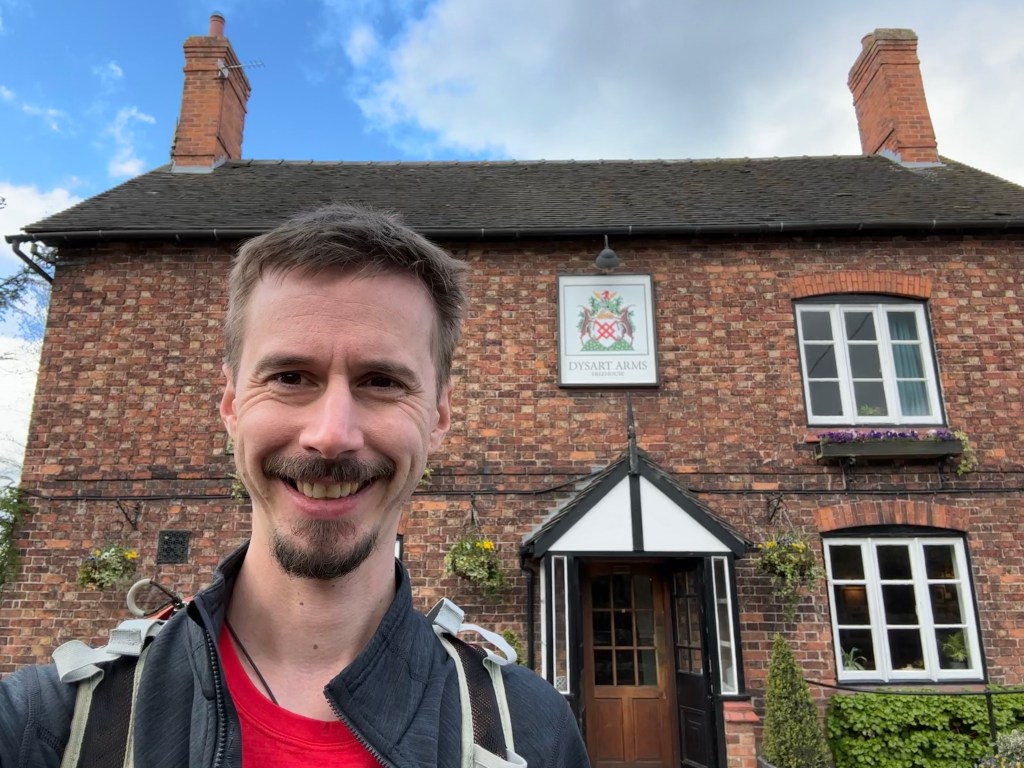
The route leaves the canal at Bunbury along country roads. Opposite the church, the ‘Dysart Arms’ was advertising ‘Elevenses’. Looking at my watch it was 11 o’clock; it would be rude not to stop.
Elevenses
After my food and refilling my water bottle I hit the trail into Beeston. The castle ruins sitting on top of a freestanding hill became my focal point. From the castles entrance (at the bottom of the hill – no way was I climbing up) I cut across fields back to the Shropshire Union Canal.
Beeston to the Right
I followed the canal all way to Chester Cathedral. It was so peaceful and tranquil walking the towpath. Listening to the birds sing and the wind rustling through the trees and hedgerows made the kilometres flyby.
Although I had a headwind, it was welcomed as it kept me cool. Soon the countryside gave way to the suburbs of Christleton then the outskirts of Chester, right into the heart of the city, below the old city’s walls.
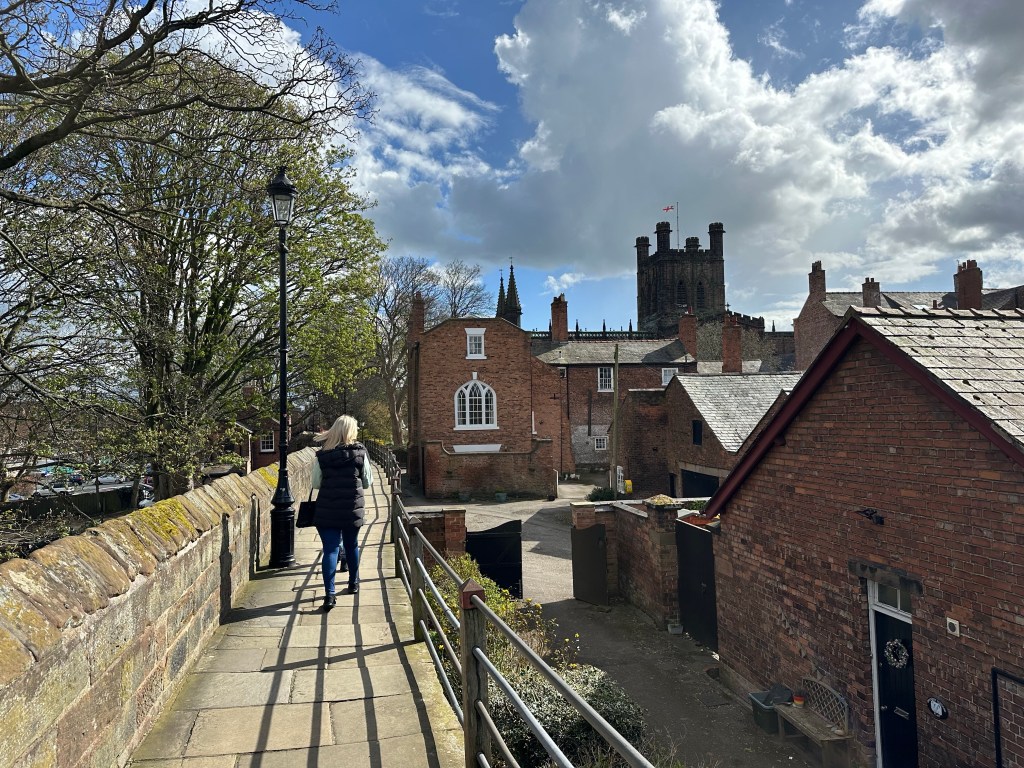
Up a flight of stairs and I was walking these fortifications with the Cathedral to my right. Following the signs, I walked along St. Werburgh Street to the entrance.
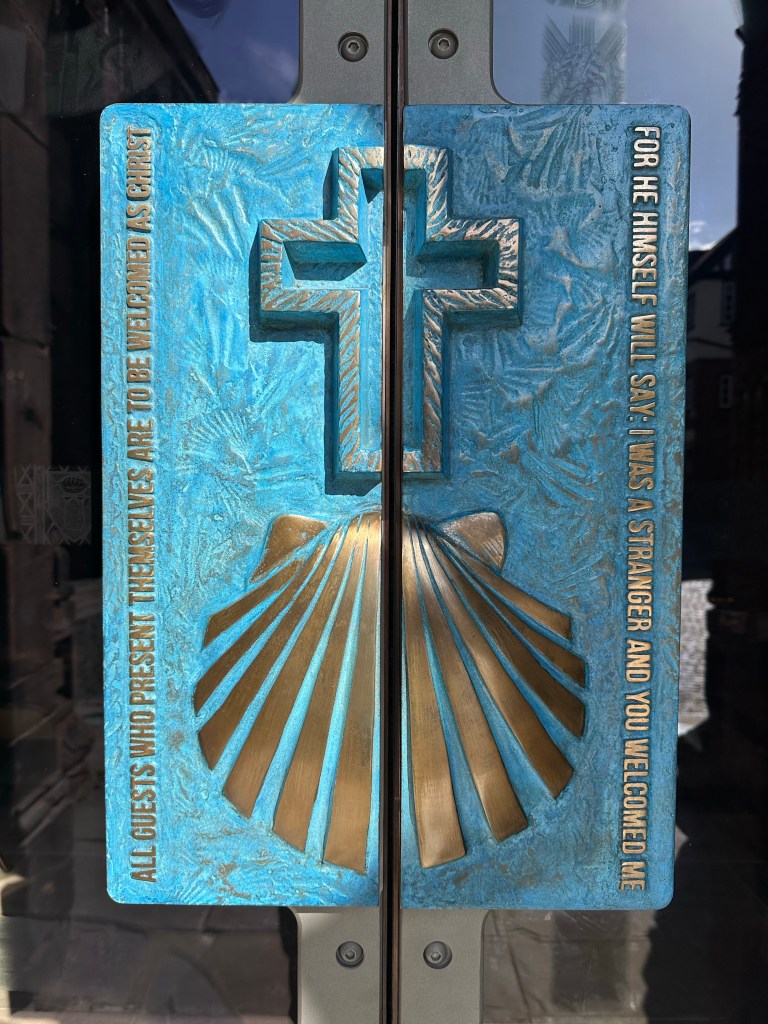
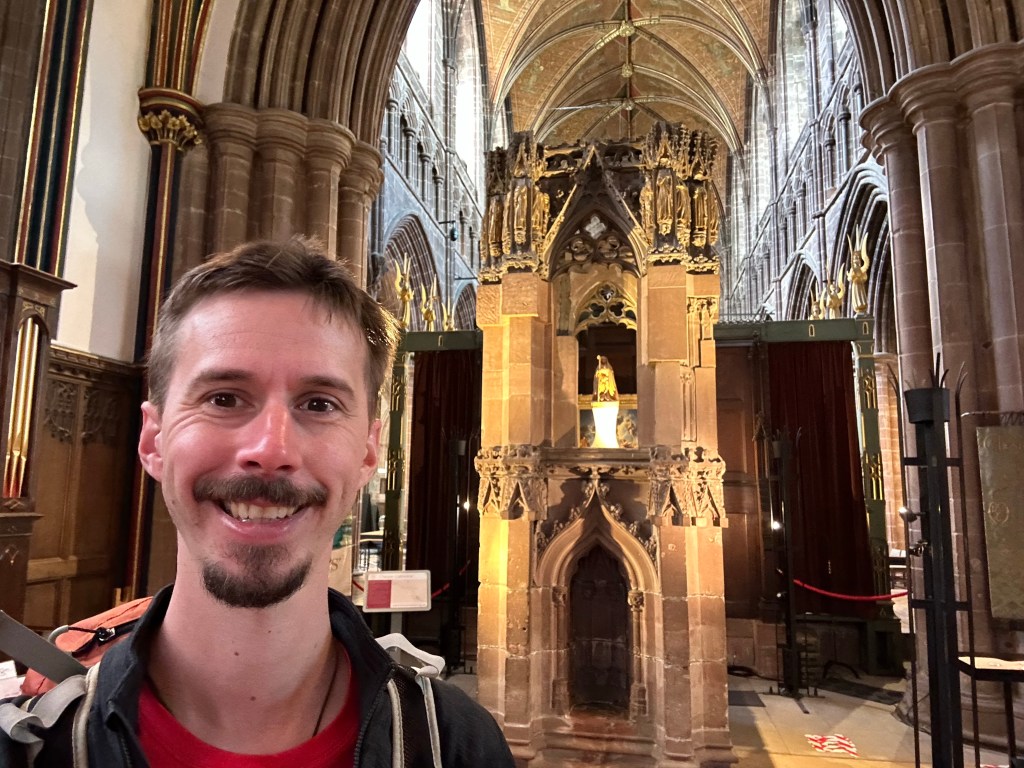
I had completed my pilgrimage, and emblazoned on a door was the scallop shell, bringing back memories of the Camino. I went inside as the journey isn’t complete until you stand before St. Werburgh’s shrine, tucked right at the back in a little chapel.
Robert Burns once penned, “The best laid plans of mice and men often go awry” in his poem ‘To a Mouse’. No truer words could describe todays journey.
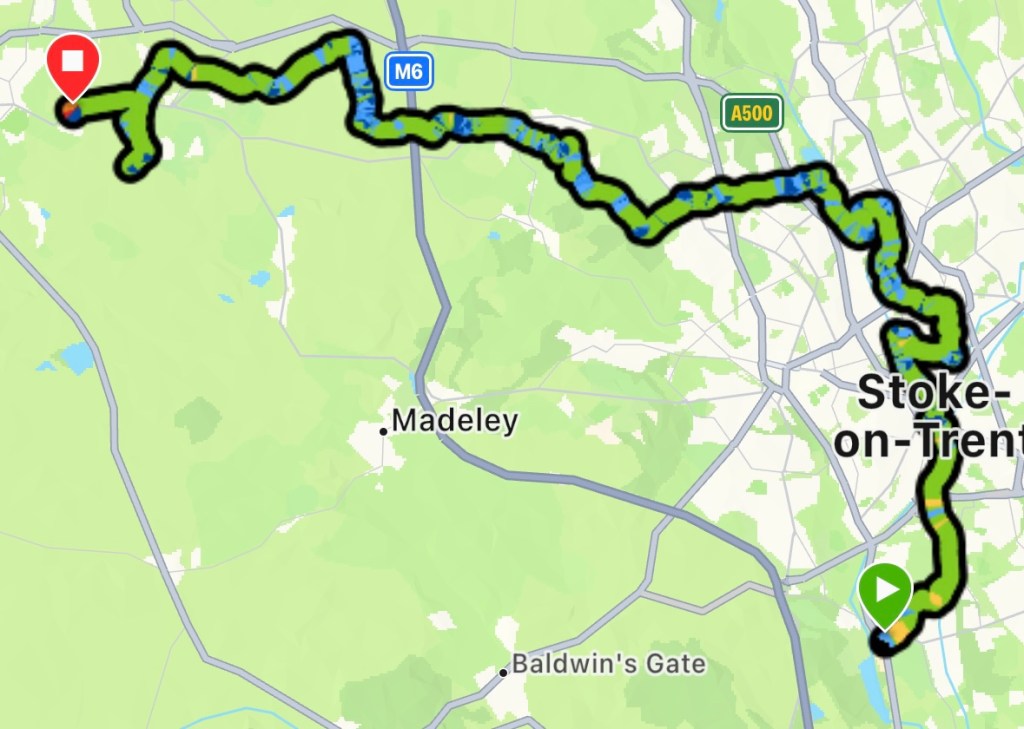
The sun was out although a little on the chilly side, when I rejoined the trail at Trentham. The path follows Longton Brook before cutting through a housing estate to join the Trent and Mersey Canal.
Seems simple on the map, but not the case. The markers were scarce and map wasn’t helpful, as it didn’t show the exact location where the route joins the towpath. I ended up wandering the cul-de-sacs for a way onto the canal for a good 15mins. In the end I had to ask a chap who was loading his car. Typically it was back in the direction I had come.
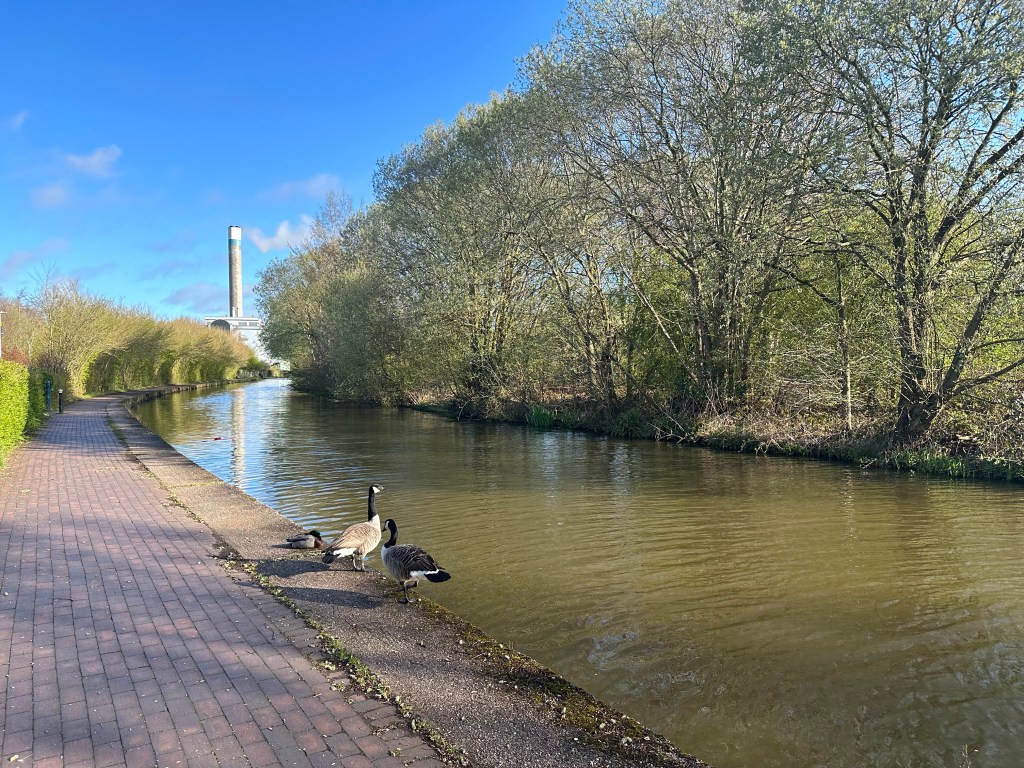
Once on the towpath it was an easy walk into Stoke, leaving briefly to Stoke Minister before rejoining the canal out to Hanley. The way goes around Hanley, Cobridge and Burslem, through all the retail and industrial parks.
The markers and the map failed me again trying to get back to the canal from Burslem. The markers led to a dead end and a path that would have led me further down the canal was just scrubland.
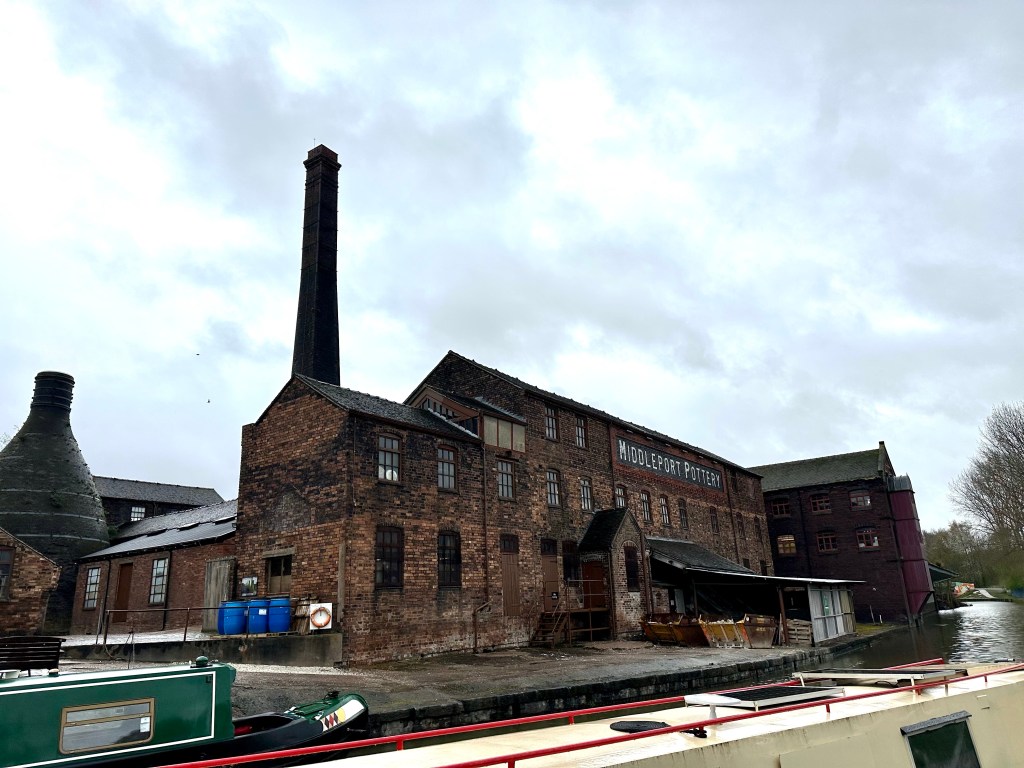
When I finally rejoined the towpath at Middleport Pottery, I wasn’t far from where I left at Hanley. Basically a loop around Stoke’s industrial estates.
I crossed under the A500 into Bradwell, where a huge line of bikers were following a hearse into the crematorium. I waited for them to pass, more out wanting a rest than continuing on.
20km in, I finally reached Chesterton, on the very edge of the city. Although that wasn’t half way, I still had about 26km to go. All the dead ends and detouring had added to my distance covered.
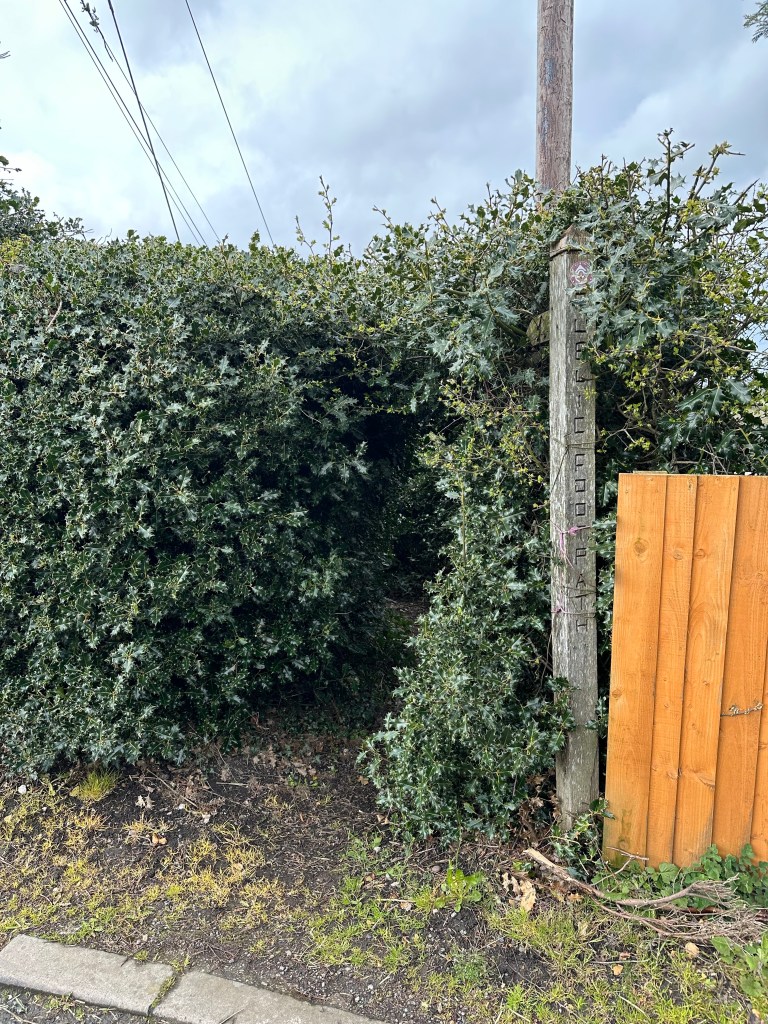
I made tracks through the countryside at last however my marker woes didn’t end in Stoke, the same problem occurred in ‘Woods Lane’. The marker was hidden within a holly bush, that the route went through. It was a tunnel of pain, by the time I reached Audley I needed a pint.
Tunnel of Holly
I called into the Butchers Arms for a swift half. A group of bikers filled the tiny bar. I ordered my drink; upon seeing my pack they enquired about my walk. They had been to the funeral however they didn’t see me resting while the procession passed.
We all had a good chat about the various hikes we had done. I could have stopped for one more, but I still had 20k to go. I left as another rain shower arrived.
I clocked over 30km and I was starting to flag, this meant it was time for music. I got my earphones out and put some upbeat tunes on. My pace quickened.
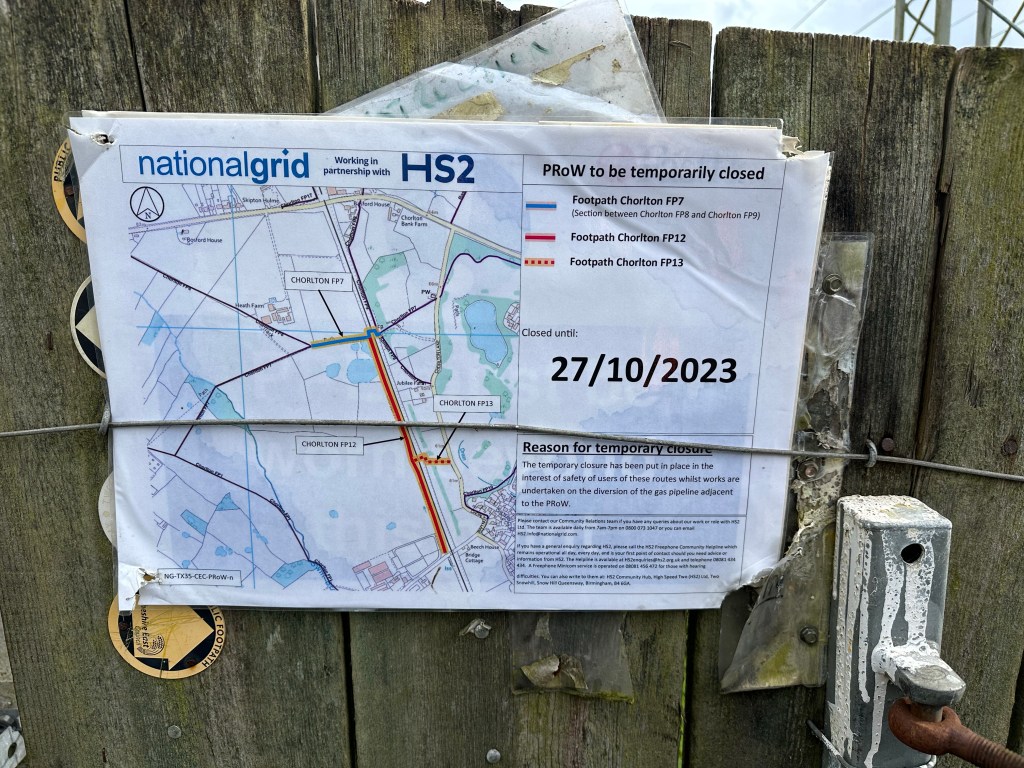
However this all came to a halt at Chorlton. Works for the HS2 blocked the route, I followed the diversion but it wanted me to go down none existent paths. Checking the map there was another route that would join the TSW at Wybunbury.
But housing works south of Chorlton scuppered that idea. I had to back track and follow the road into Hough, I had wasted an hour with this folly.
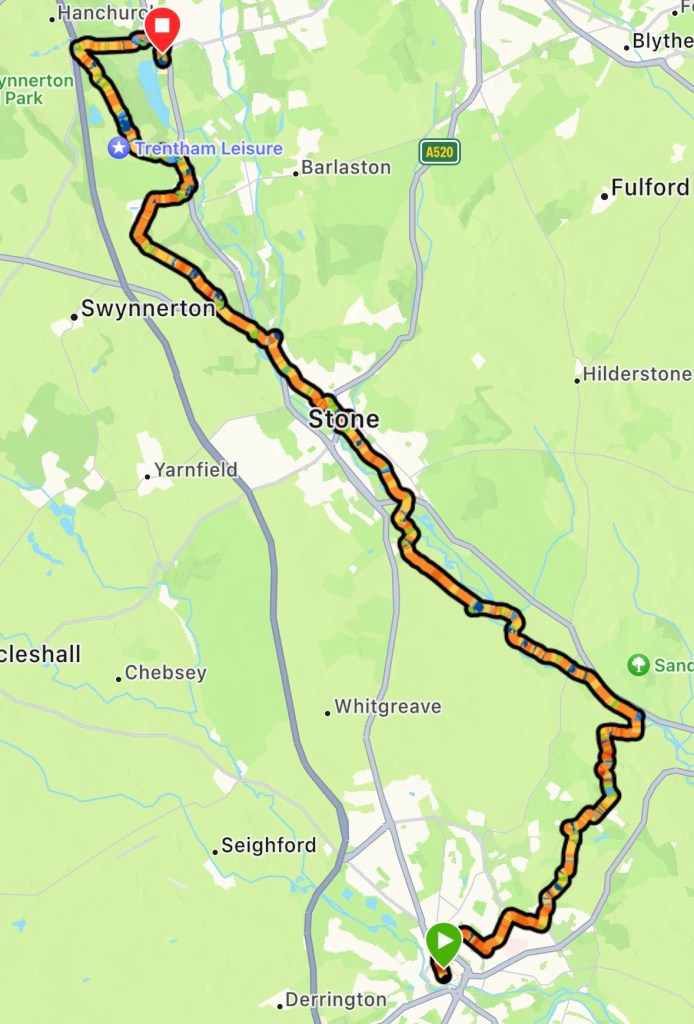
The distance to my destination was going up by this point and I had covered 39k, 12k still to go according to the app. I had to call a taxi to take me into Nantwich. My watch was showing 41km by the time I got into Hough; pretty much what the distance should have been if the day had stuck to the script.
With that in mind, I don’t feel it would be cheating if I set off from Nantwich tomorrow and not get a taxi back to Hough.
Hopefully my marker nightmare is now over and I’ll be in Chester tomorrow evening! The end the Way of St. Werburgh.
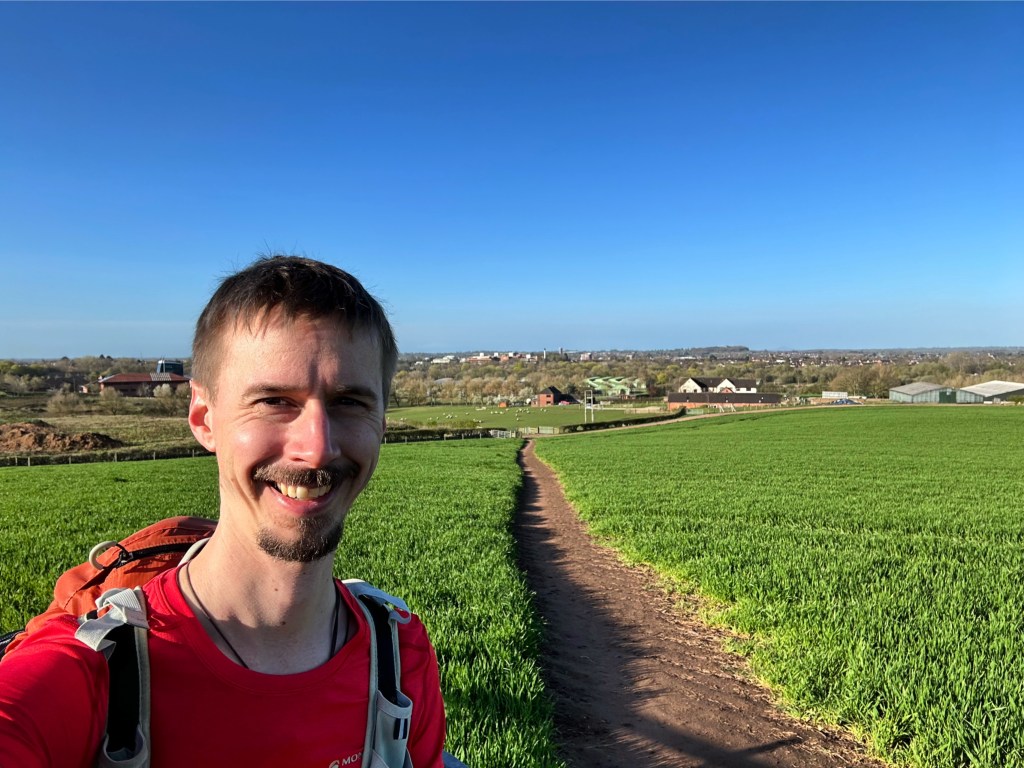
Absolute glorious start of the day, not a cloud in sight with the temperature cool enough to make it perfect walking conditions.
Picking the trail up from where I left off, at St. Chads, it follows the high street up and around HMP Stafford. I didn’t envy the prison officers who were arriving to start their shifts.
After cutting through some allotments I was on the stretch out of the town and into the countryside. A short rise to Beacon Hill gave lofty views over Stafford.
From there I passed through Hopton and inadvertently took the scenic route into Salt before joining the towpath along the Trent a and Mersey Canal into Stone.
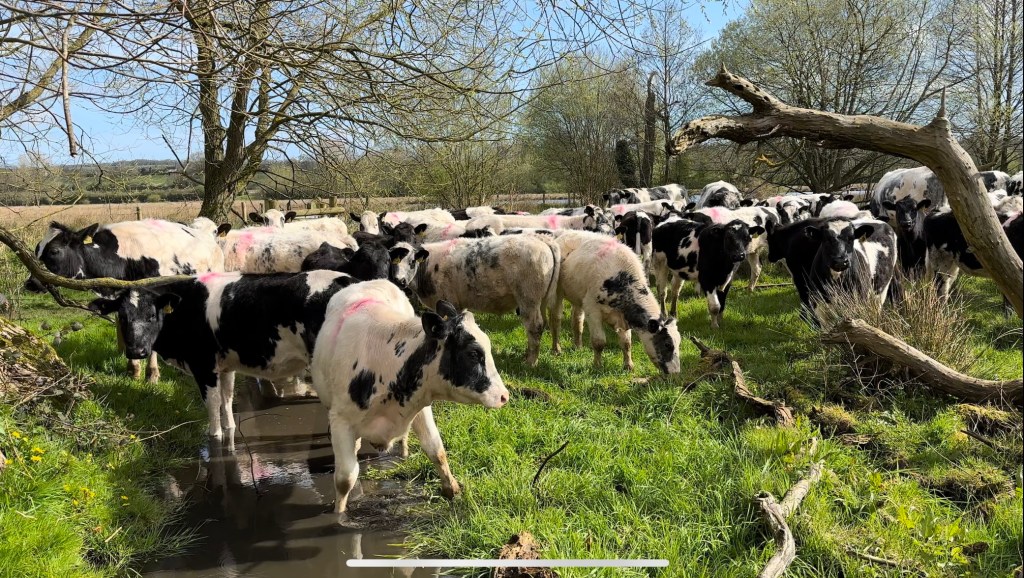
The towpath was a bit tricky to navigate due to slippery mud. At Burston, the path leaves the canal and cuts across farmland. Over a very boggy field, which the exit gate was blocked by cattle. (What a day to choose my red top!)
Mooove out of my way
I slowly made my way through the inquisitive cows trying to avoid the puddles hidden by tufts of grass. Although they came up to me they wouldn’t get within my arms reach, and they parted way to allow access to the gate.
About a 1km more and I was back on the towpath into Stone; I arrived for midday, perfect timing for lunch. I called into a cafe for a halloumi and red pepper wrap.
Conscious that the good weather wouldn’t last, I soon got underway. After a brief walk along the canal, I left Stone behind, winding my way up Bury Bank. This is one of the possible places where St. Werburgh was born.
It was at this point I could feel the rain was in the air; I reluctantly put on my waterproofs in time for the first droplets to fall.
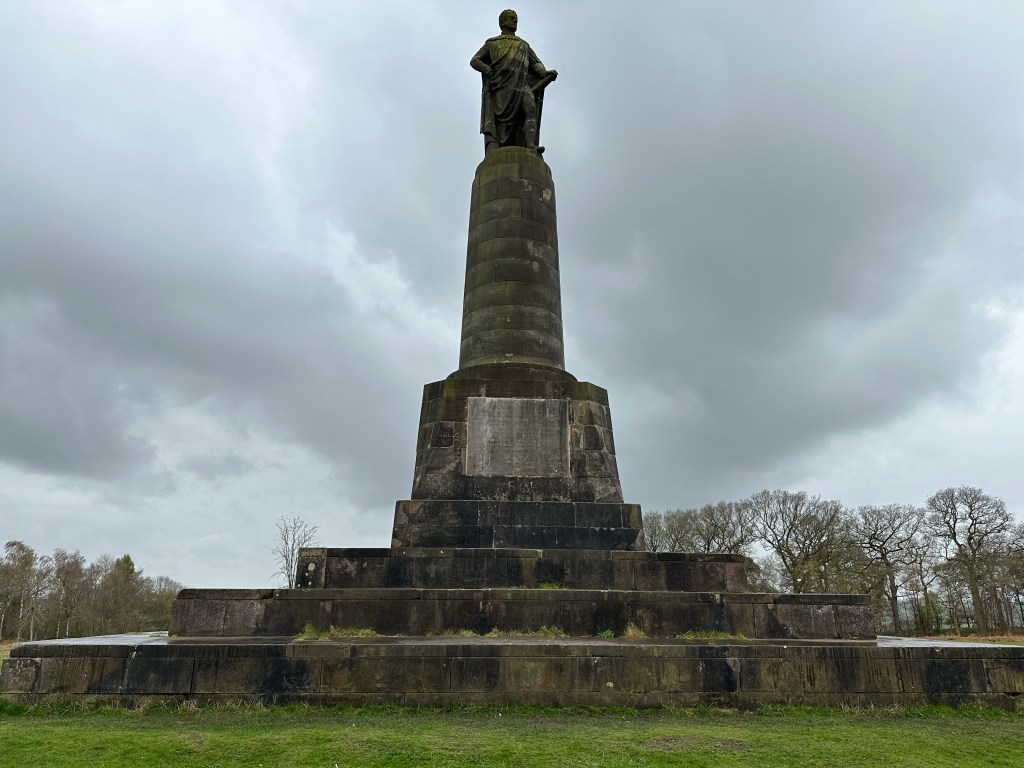
I descended into Tittensor marking the last leg for today. After a steep ascent to George Granville’s monument that over looks Trentham Gardens, it is back down to the edge of the monkey forest. (I think the rain had kept them indoors, as I didn’t see any)
George Granville watching over Trentham
As I had just gone downhill, that means I now must go up. It was a very steep incline through the woods, it felt like the highest gradient so far on this trek.
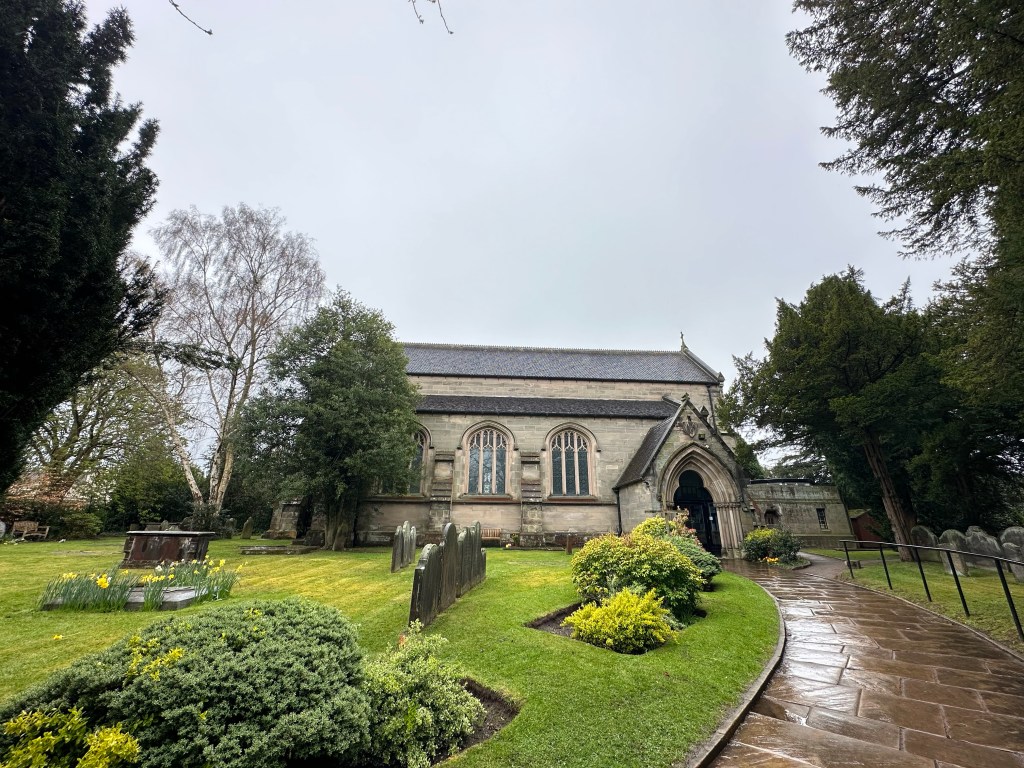
It joins a ridge line called Kingswood Bank that I followed for a kilometre or so before descending into Trentham where I ended this stage at the church. I met my dad at the entrance to Trentham gardens, I’ll be staying at his tonight and will give me a lift back in the morning; although tomorrow is the big one and the forecast predicts gale force winds and plenty of rain. I’m having flashbacks of Skiddaw last October!
It was a wet start to the day and to make matters worse, my phone hadn’t charged over night, with only 34% juice left. Figuring it was the cable, I had to wait around for the shops to open to get a new one.
Tesco opened at 8am. 30mins later I had a new cable, my lunch and started out on the walk. Being a veteran on these sort of jaunts, I had packed my power bank. My battery worries now over, I got to what I do best, walking.
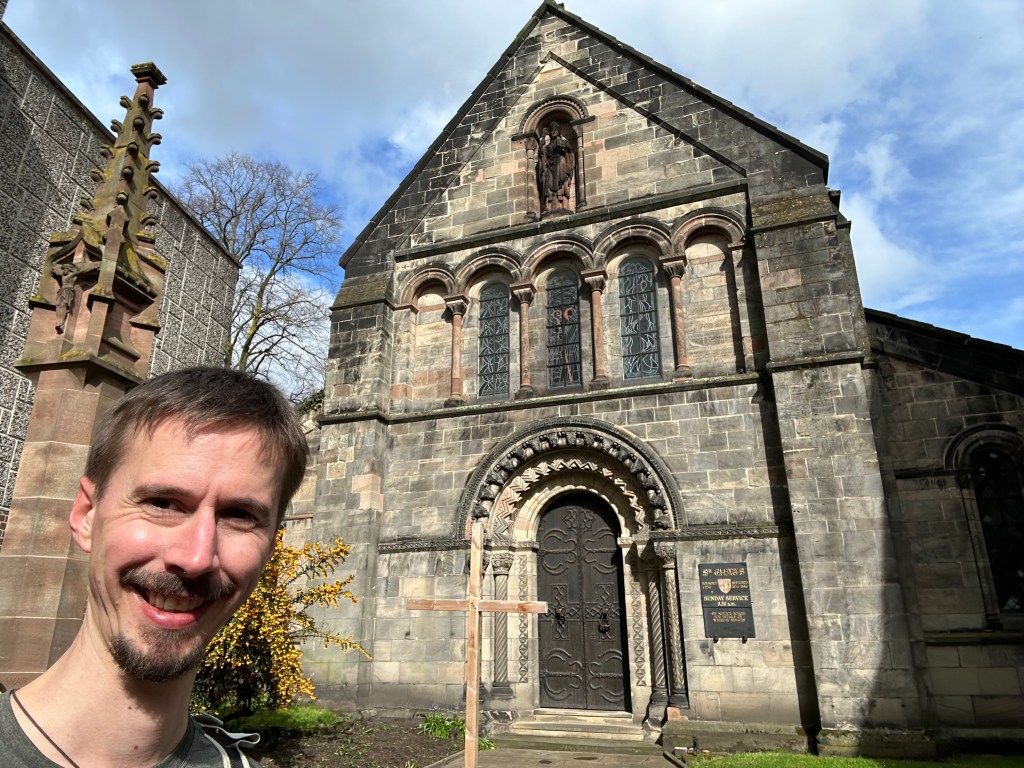
St. Chads, Lichfield
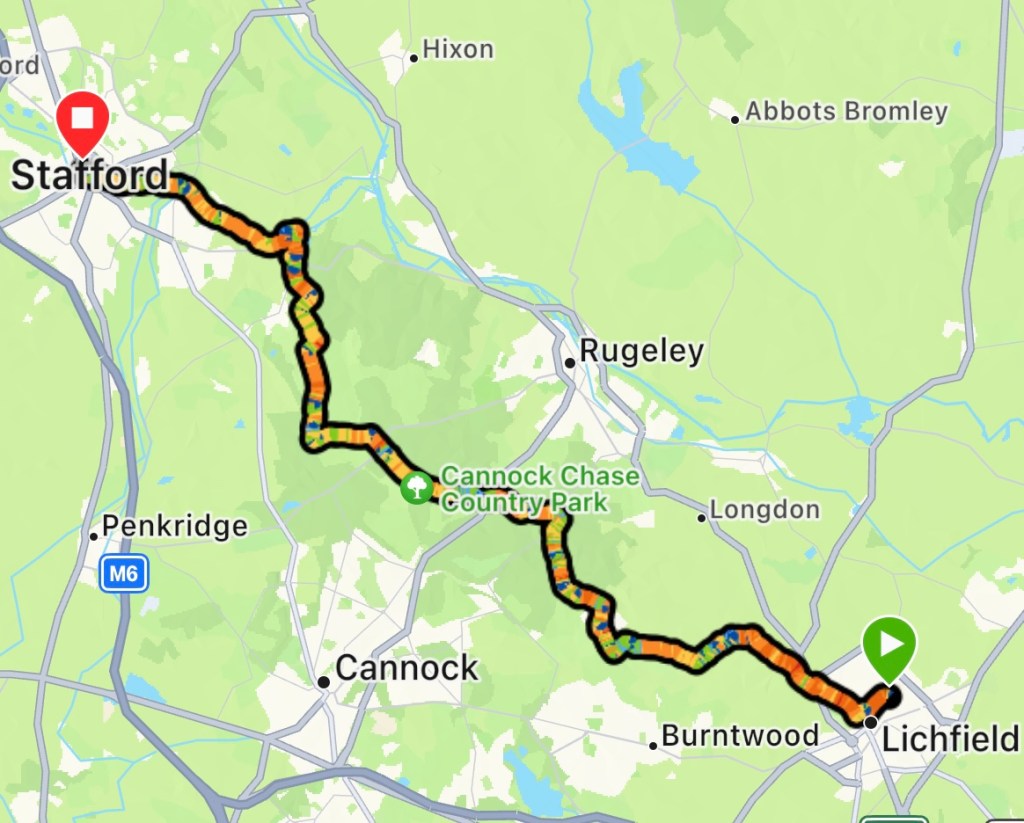
Three kilometres later I had left Lichfield behind following a country road in the direction of Cannock Chase. Thankfully the rain eased.
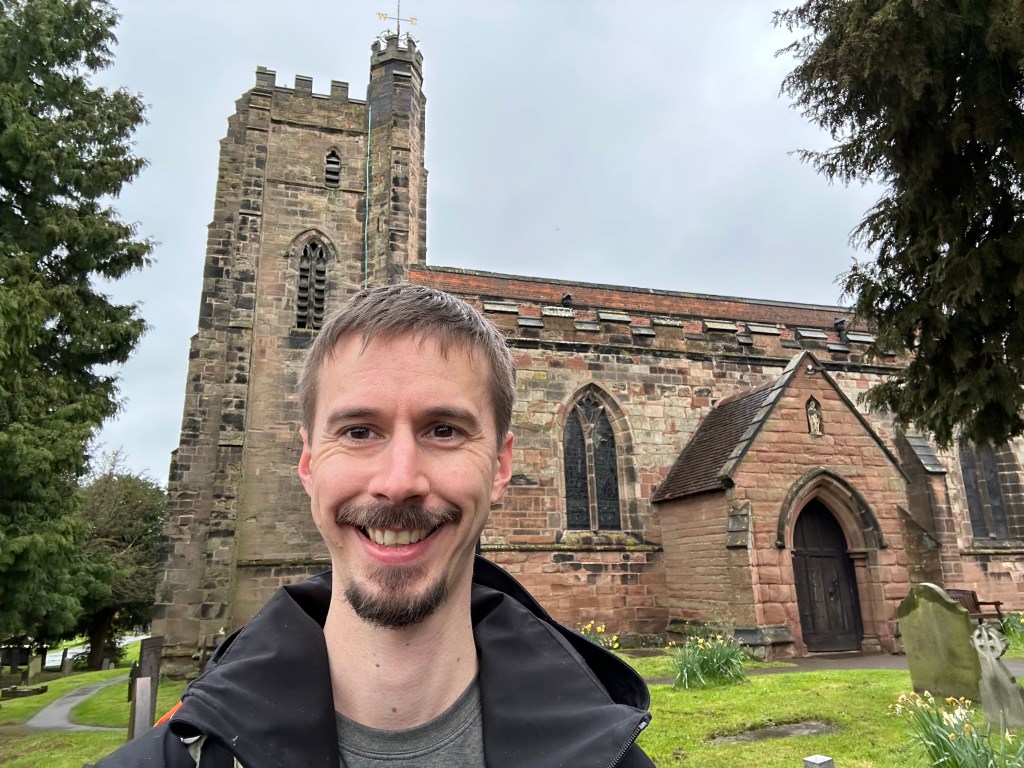
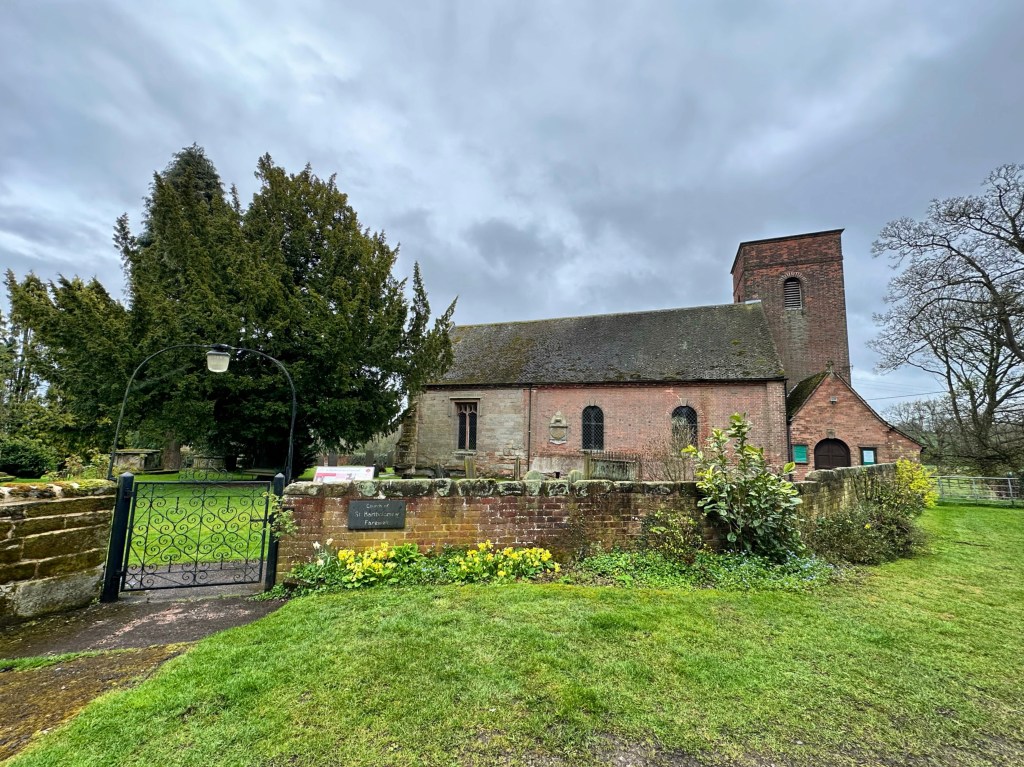
The first village out of Lichfield is Farewell; the route passes behind the church. Saying farewell to Farewell Church, it is country fields and small forest trails to Gentleshaw, which is on the edge of Cannock Chase. 10km down!
Farewell Church
Into the chase I went. Woodland as far as the eye could see. This is also the hilly section of day. Following the undulating path dodging mountain bikers, whom were more mud than cyclist, I enjoyed the scenery.
The sun was desperately trying to break through the dark grey clouds, but they loomed over menacingly. At 14km I stopped and ate my pasta while sitting on a gate. There is a lack of picnic benches!
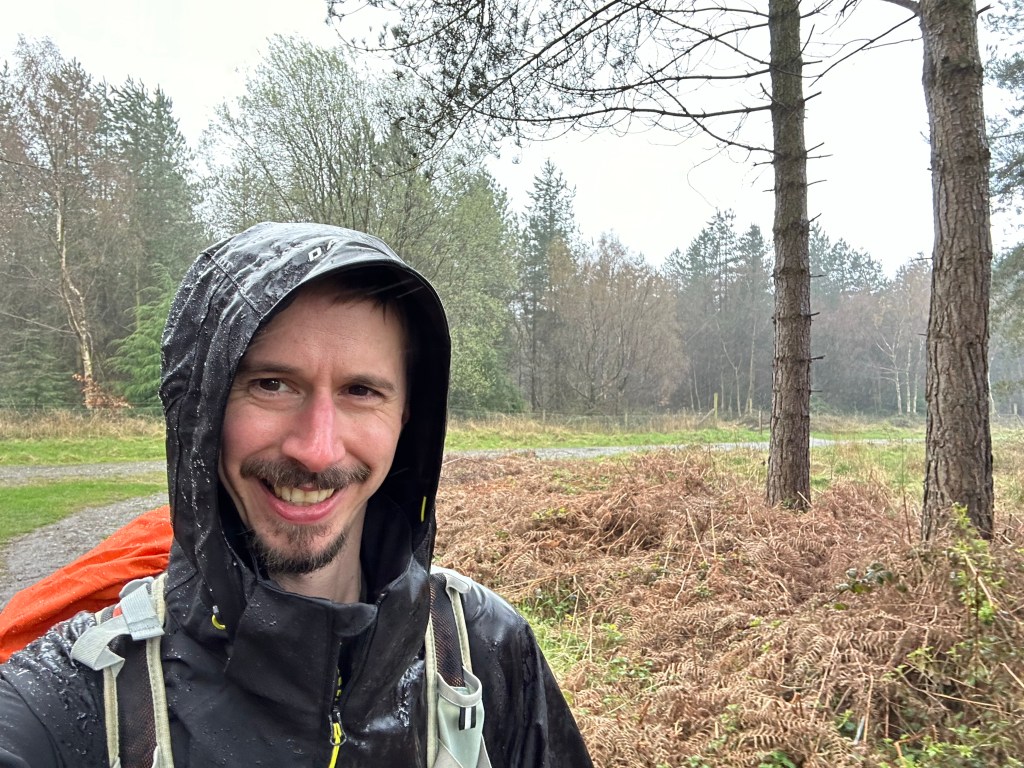
After another 2km, the down pours forced me to put my coat back on and zip up. With the wind, the rain was driving sideways. After 10mins I was sure that was it for the day. However as quickly as the deluge started, it was chased away by beaming sunshine! Best thing is, it remained sunny for the rest of the way into Stafford!
Who’s idea was it to walk this week?
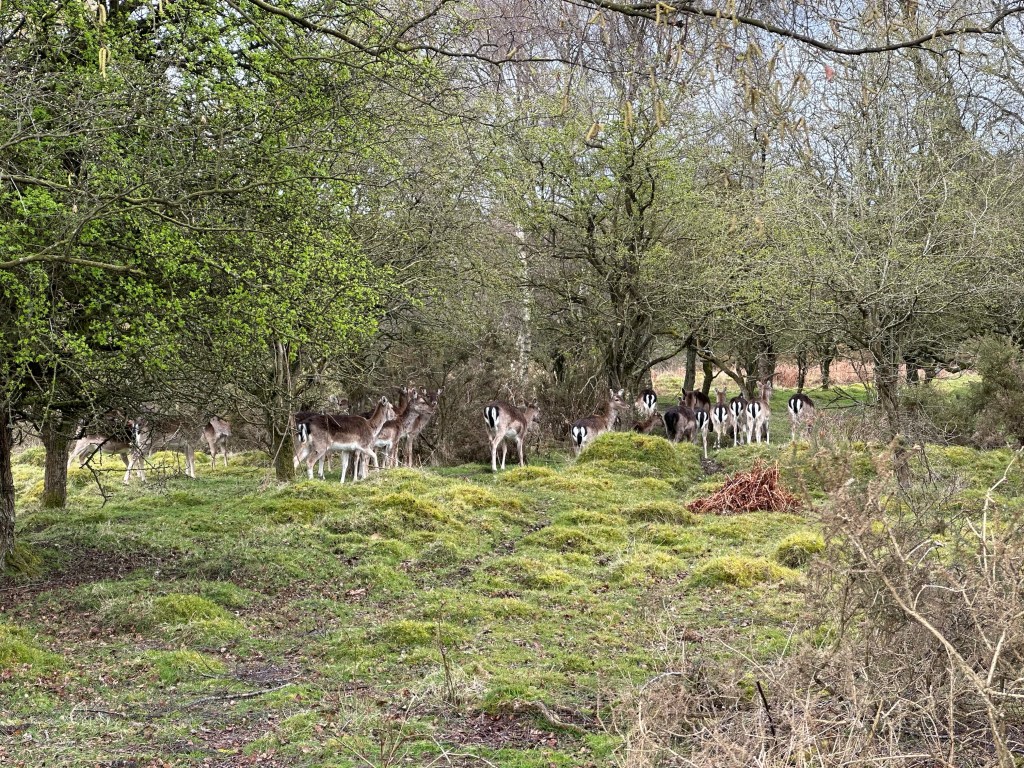
While weaving through the woods I came upon a herd of deer. At first I thought they were painted wooden sculptures (they weren’t moving and I didn’t have my glasses on). As I got closer I saw one of their ears twitch.
Shortly further on I came up to an even bigger herd, right by the path. Although they kept an eye on me, they didn’t seem to mind my presence.
Have they got penguins for tails?
With the sun shining and the route now going gently downhill, I was in my element. I exited Cannock Chase at Milford to begin the last leg into Stafford.
I chose to join the Staffordshire and Worcestershire canal to avoid a section that passes sewage works. Eventually I left the canal to follow the banks of the river Sow into Stafford, completing the day’s walk at St. Chads Church. It’s been a journey of the two chads.
I arrived into Lichfield early afternoon on this glorious sunny spring day. I took a stroll to St. Chads to have a look around while it was nice. I leafed through the visitor book and it seems I’m the first to make an entry this year stating I’m beginning the Two Saints Way.
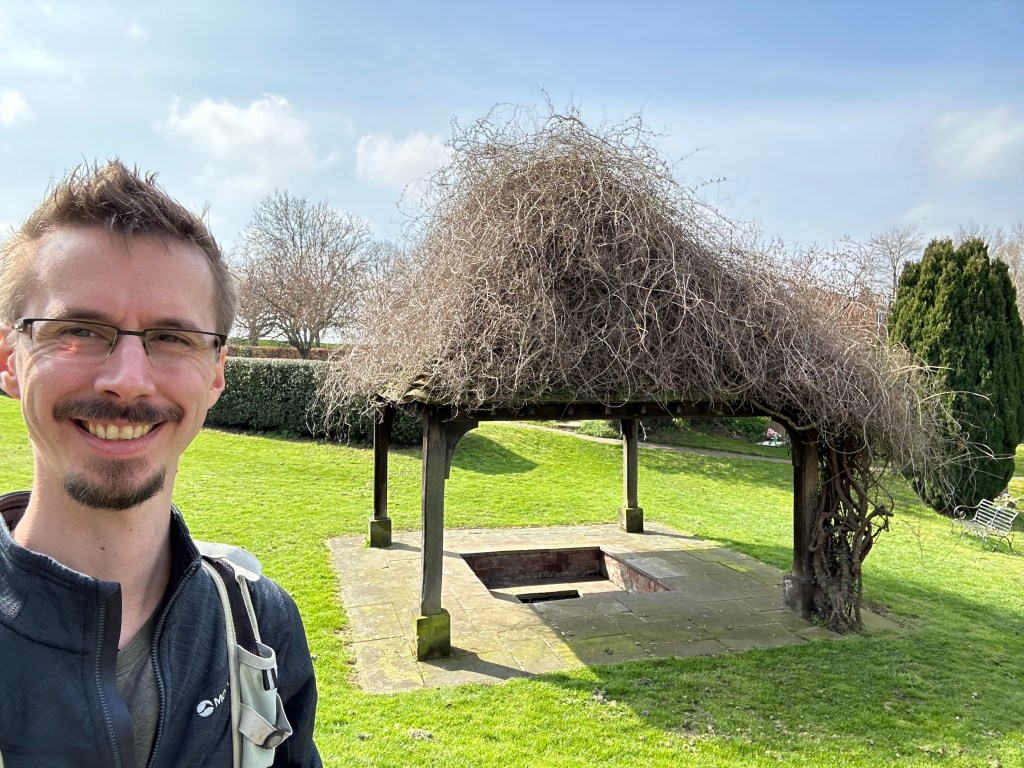
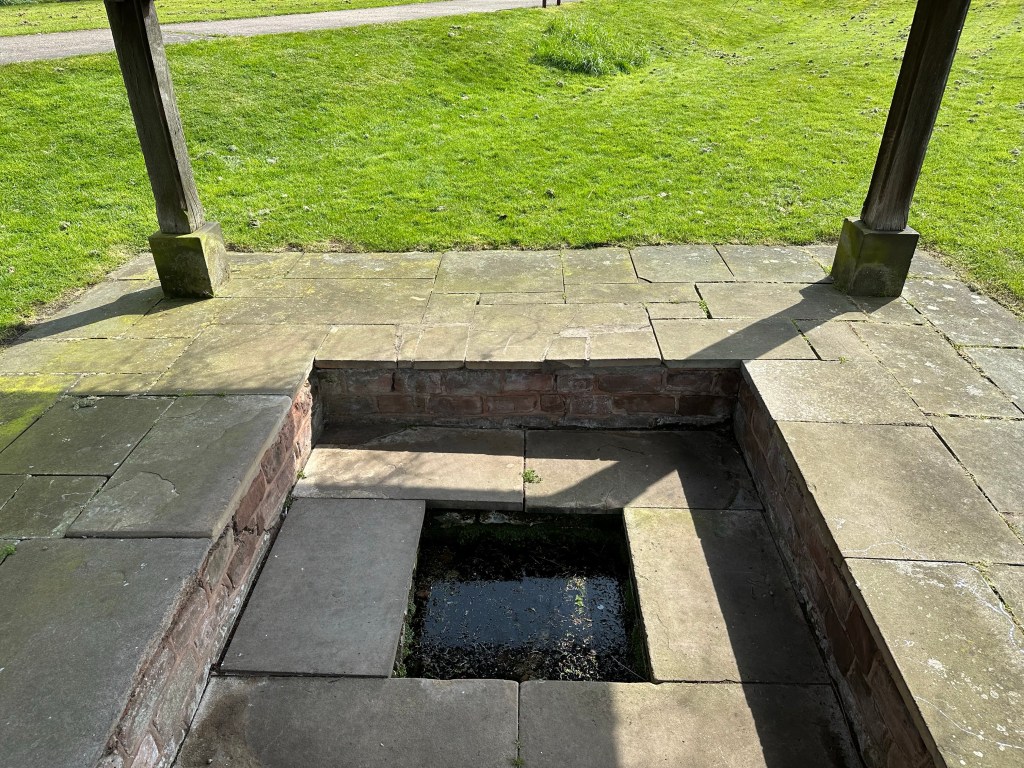
I found St. Chads infamous well and thought of dipping my feet in, however the water didn’t look too inviting.
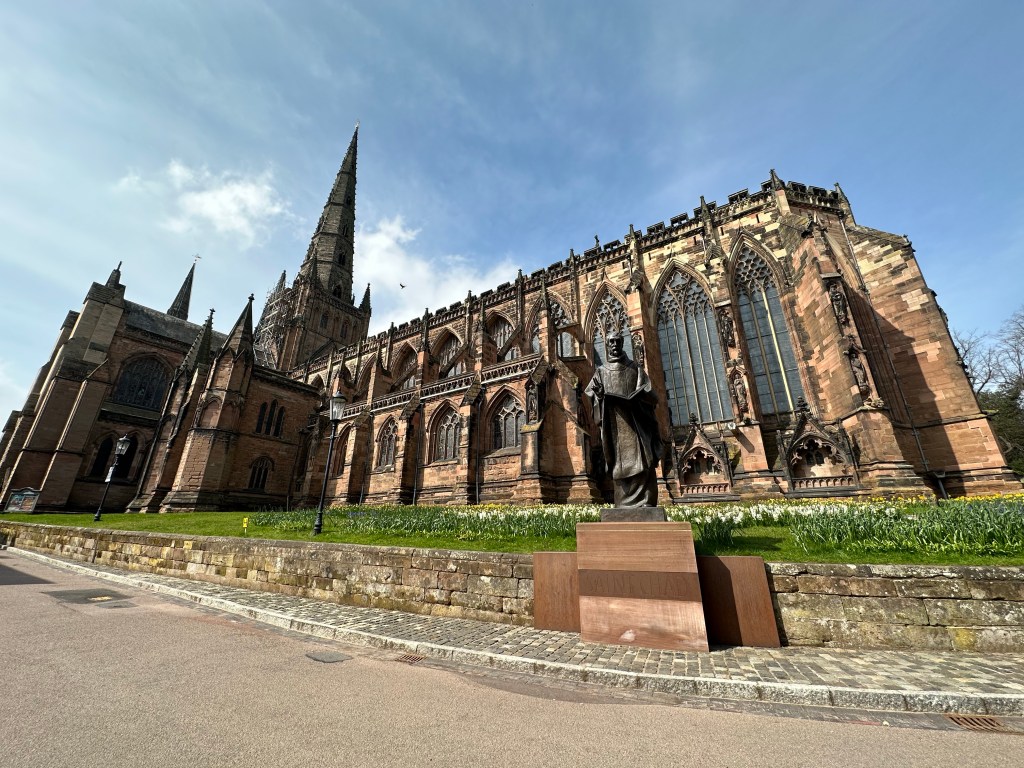
I then followed the banks of a small lake to the cathedral where I saw the man himself. The masonry work in the red sandstone to this gothic style building is exquisite.
Apparently the cathedral is one of only three in England that has three spires and the only one of the three that is medieval.
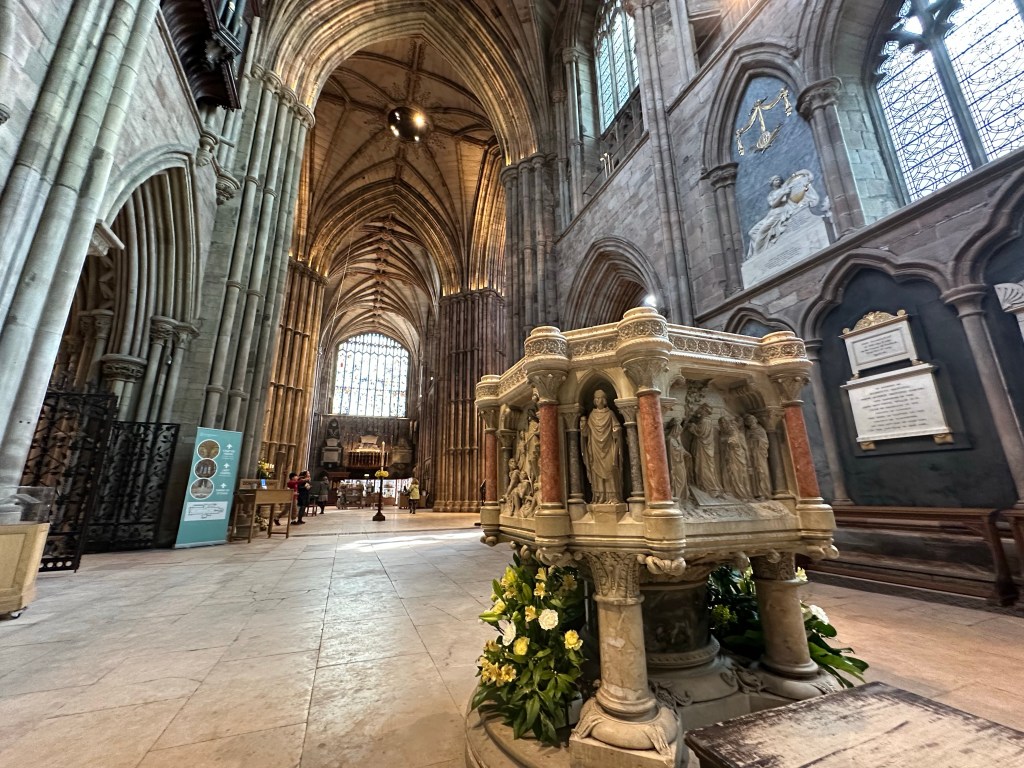
Being Easter Sunday, the city is very quiet enabling me to enjoy the sights with no crowds. Along the walls are stone sculptures, tall stained glass windows and an elaborately decorated font.
I had look around the centre, (which is very small for a city) to grab a bite to eat, followed by a quick pint at the king’s head before check-in at my lodgings for the night.
I dumped my bag in my room and changed into my ‘town’ shirt, ready to search for another watering hole and scout out somewhere for dinner. (Got to get the calories in ready for tomorrow – well that’s my excuse)
With only a week to go, I’m getting prepared and very much looking forward to my first through hike of the year. I’ve even ordered some new walking trousers! I’ve given my boots a good clean and waterproofing, and my rucksack is all packed and ready. I’ve plotted my routes on the Ordnance Survey App and booked my train ticket to Lichfield. I’m all set!
I’ll post a daily blog of my journey as usual, however, I’m going to dabble in the Instagram for this trip. I’ve never used this platform and after some convincing from my brother, he has assured me it will be a good thing. I’m not sure how my foray with this social media app will pan out, but I’m sure I’ll be able to stumble my way through it.
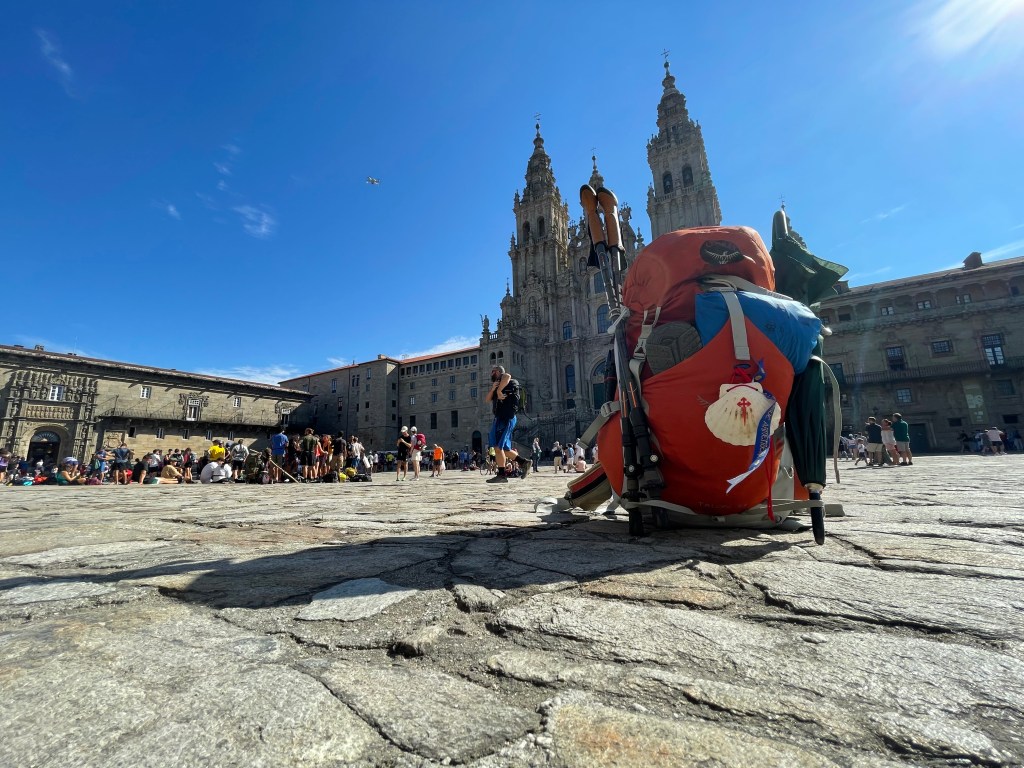
The gear I am taking is pretty much what I took on the Camino Portugués which can be found here. I’ll be going in my trusty Scarpa Mistral GTX rather than my trail runners; the UK weather has been very unpredictable as of late.
The trousers I’ve gone for, is a pair of Revolution Race Nordwand Trousers. A brand I have never heard of, but thought I’d take a plunge as these had good reviews.
Although on first impressions they are a bit pricey for the quality, but I haven’t tried them out in anger yet. I think I will swap out my poncho for a waterproof jacket and trousers, just for the convenience while in the towns, but I haven’t decided yet, and probably make the decision as I leave my front door!
According to the maps, the first day will be the hilliest and although the last two are long, it is mostly along canals. I should be ok and as I’m setting off on in April unlike I did for the Cotswold Way, there will be more daylight to play with, and I won’t find myself in a situation where I’m some distance from the stage end and losing the light! (Unless I get waylaid by a nice pub or two)
I’ll be arriving in Lichfield Sunday afternoon and spending the night there before beginning The Way of St. Werburgh Monday morning. Can’t wait!
Here is part two on the figures for the Two Saints Way. The Way of St. Chad goes in the opposite direction to St. Werburgh, starting in Chester. Like St. Werburgh, he too was active in the 7th century however unlike our goose loving saint, he came from a Celtic Christian background.
St. Chad was born in Northumbria to a wealthy family and spent his early adulthood on Lindisfarne becoming one of St. Aidan’s disciples. He spent time travelling in Ireland where St. Aidan was originally from. While abroad, his older brother Cedd, a well known figure in the church for his missionary work in East Anglia, had established a monastery at Lastingham in Yorkshire.
However in 664AD he died from the plague, but before he passed away, he had appointed St. Chad to take over his position. During his time at the monastery he gained a reputation for kindness and hospitality. Meanwhile another important figure of the time, St. Wilfred, was to become the Bishop of York and had left Britain to be ordained in France. (Britain at the time was considered too pagan for ordination to be officially stamped by the Catholic Church – I guess we have always been an uncouth lot!).
The King of Northumbira grew impatient with the lack of religious guidance and ordered St. Chad to Kent to be ordained as the Bishop of the Northern Church at York. He took to the task enthusiastically, and while traveling he would refuse to go by horseback, but instead walk. (You can see why I like this guy!)
However on St. Wilfred’s return it all got a bit political. He wasn’t happy St. Chad was ordained and the Bishop of Canterbury charged him of illegally holding his office. Not one for politics and power, St. Chad had only taken up the post out of a sense of duty and didn’t consider himself worthy of the position; he was happy to step down and return to Lastingham.
The Bishop of Canterbury was so touched by his humility and officially ordain him. In 669AD he was called to be the Bishop of Mercia, bringing him to the Midlands, specifically Lichfield. He is reputed to have performed baptisms at the well in St. Chad’s Church within the city, where he would spend hours praying while standing in its waters!
He died in 672AD and was venerated as a saint; a marble shrine adorned with precious stones and gold was commissioned to house his remains. During the reformation, the shrine was taken down and his bones were hidden over the centuries by Catholic families living in Staffordshire. Some were discovered at Aston Hall; these are now held in Birmingham Cathedral.
No fables involving fowl this time, but he is a fellow long distance walker and probably the reason why he spent such a long time standing in a well! He’s a fitting character for this through hike and I can’t wait to start (I wonder if there is a well to dip my feet in at Chester?!)
Another week closer to my first through hike of the year, and here is one of two posts giving some background on the Saints this pilgrimage is named after.
You probably have never heard of St. Werburgh and why her shrine is the destination for pilgrims. So here is a TLDR synopsis.
St. Werburgh had great influence in the 7th century for the spread of Christianity through the kingdom of ‘Mercia’, which covered the entire midlands, south of the the river Dee and Humber and north of the Avon and Thames.
She was the daughter to the Mercian King Wulphere. It is believed she was born at ‘Bury Bank’ outside the village of ’Stone’ in Staffordshire.
She entered a convent at the Abbey of Ely where her aunt was the Abbess. She adopted the modest life of a nun, giving up the luxuries of royalty.
She eventually became responsible for the all the convents in Mercia, and through the wealth of her family, she established numerous convents throughout the kingdom that became models of the monastic lifestyle.
She had founded a monastery in Weedon, a village that is a stones throw from me! Before her death she visited all her convents and was buried in Repton. However, she was re-interred due to the invading vikings, at St. Peter and St. Paul’s Church, which is now Chester Cathedral.
The goose that has become associated with St. Werburgh, originates from a story about the Weedon convent. A flock of wild geese ravaged farmland belonging to her, and as a punishment she locked them up indoors overnight; however she pardoned them the following morning and released them from captivity.
During the night a servant had stolen one; the flock realising they were one down, noisily pestered St. Werburgh. Grasping the meaning of the racket, she tracked down the servant to secure the release of the bird.
The flock then flew away, never to return and interfere with convent or it’s lands again.
Whether it is on a long journey like the Camino or a short walk like the Two Saints Way, there are such fables like this, that add a bit of culture to the walks.
It is becoming a theme with me; three-four months after a through hike/Camino, my legs get restless and pine for another long distance walk. This happened leading up to the Cotswold Way and it is now happening again.
I’ve been toying with different ideas for through hikes, and I had settled on walking the entire coast of the ‘Isle of Wight’; a small island off the south coast of England.
However, having worked out the logistics and costings, it would be cheaper to go back to Spain and walk a shorter route, such as the Camino Inglés.
A family member recently visited Chester and spotted the scallop shell on a signpost, that as you know, is the symbol for the Camino. After a bit of research, it turns out there is a pilgrimage between the cathedrals in Lichfield and Chester. It is called the ‘Two Saints Way’.
My Camino obsession had been tingled, and so I went into full research mode. Disappointingly there is very little on YouTube, which is usually a good starting point and the websites around this route are a bit clunky and not very helpful, especially regarding accommodation.
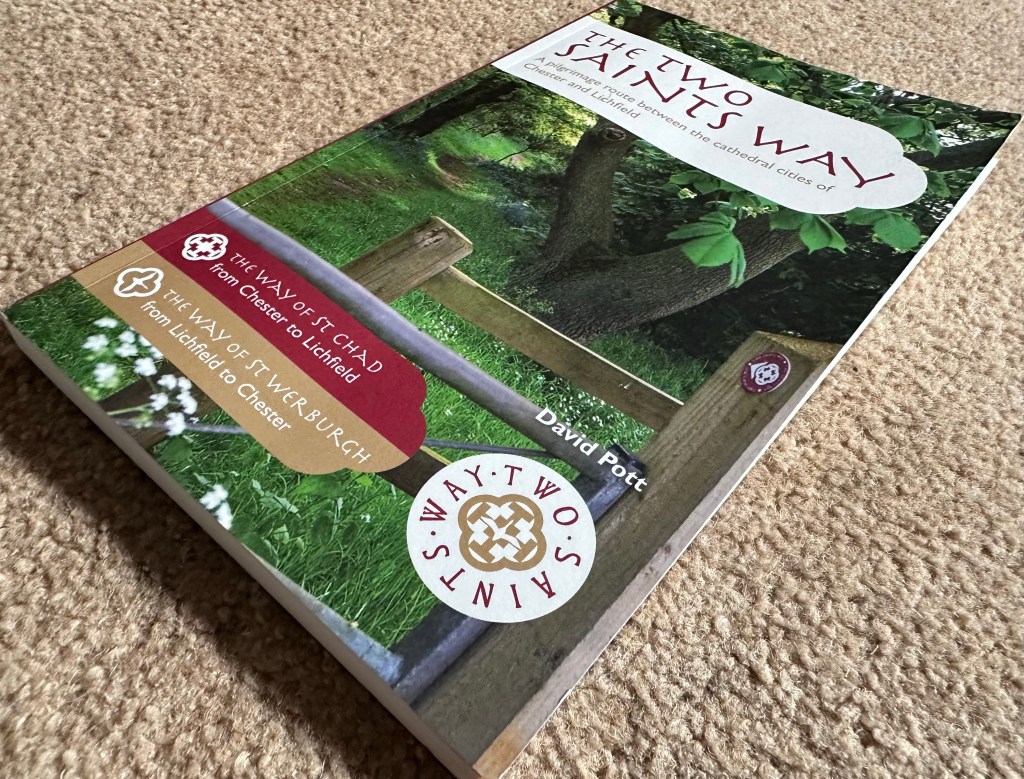
Next stop was Amazon to see if there are any books/guides. Luckily there is: The Two Saints Way by David Pott.
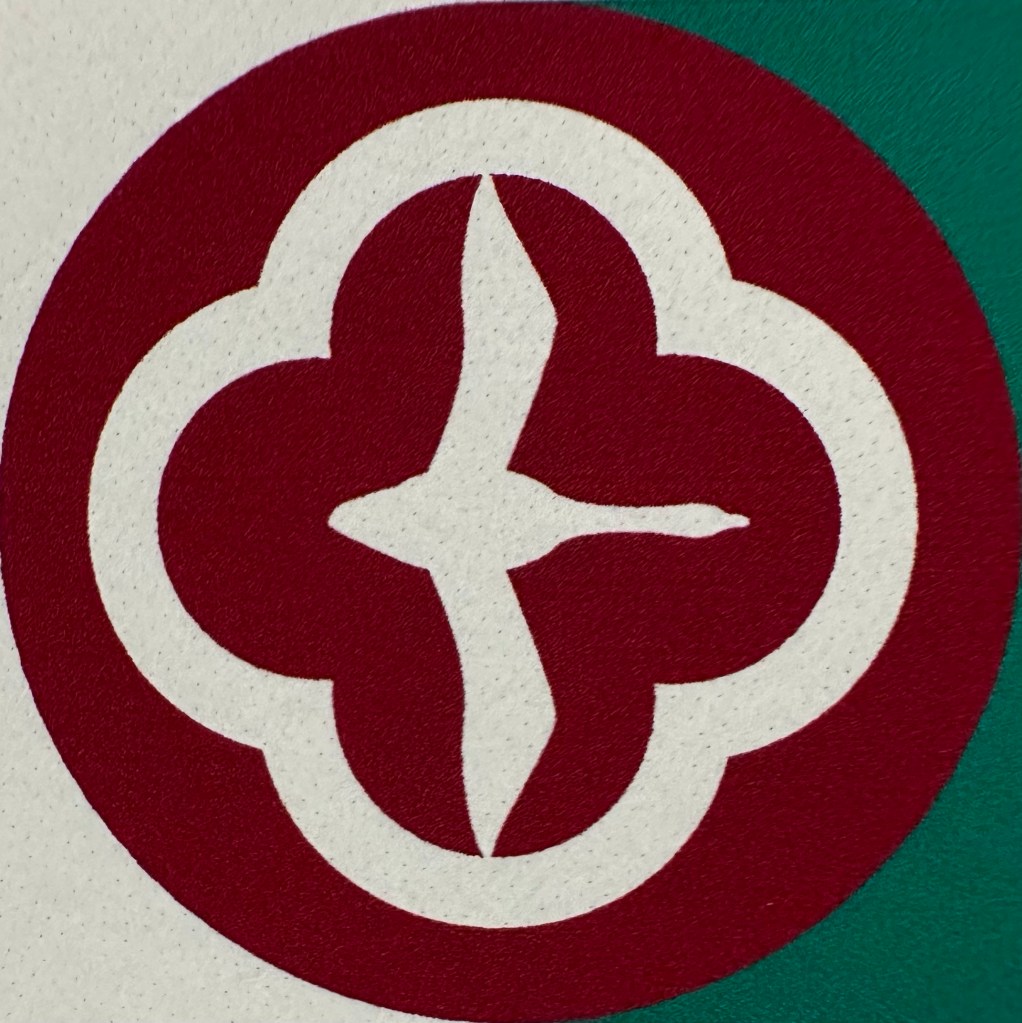
Depending on which city you would like to start in, determines the route. I’m planning to start in Lichfield following ‘The Way of St. Werburgh’, which is marked by picture of a goose, a bird that became synonymous with Saint.
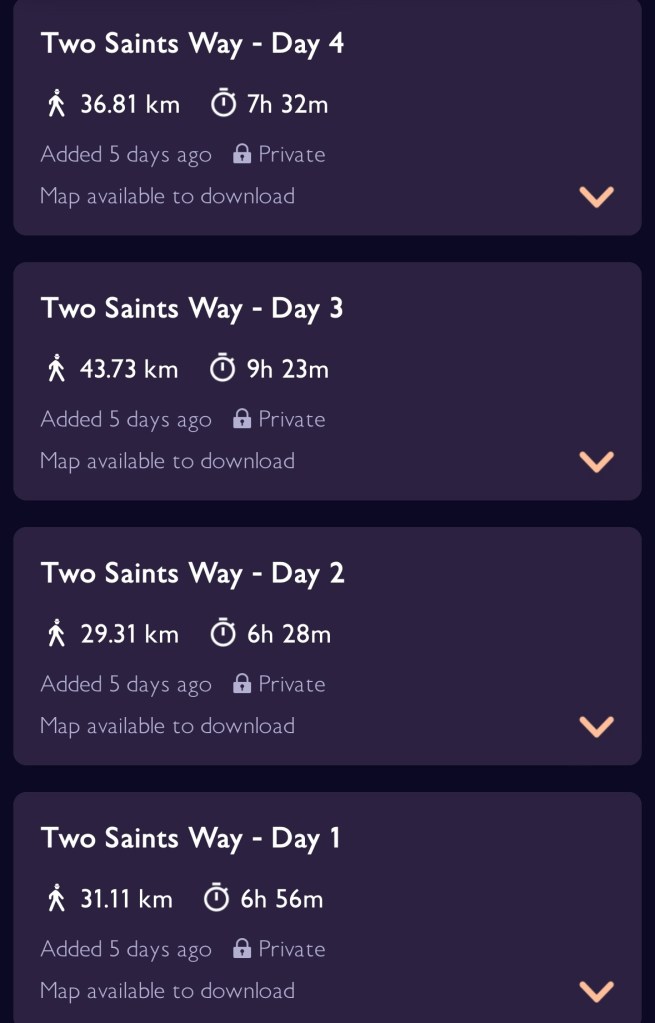
The guide recommends undertaking the pilgrimage over seven days, however some of those days are very short and you know me by now, I’m a glutton for punishment; I’m going to walk it in four.
The stages will be:
Lichfield to Stafford (20 miles)
Stafford to Stoke-on-Trent (23 miles)
Stoke-on-Tent to Nantwich (25.5 miles)
Nantwich to Chester (23.5 miles)
92 miles! I’ll be stopping at BnBs and one night with family in Stoke. I’m forgoing the tent this time so I can cover the distances at a quicker pace; also means I’ll be using my Camino gear which I’m accustomed to carrying.
Five weeks from now I’ll be donning my pack, tying my laces and walking my first through hike of the year; a little bit of practice before my return to Sarria on the Camino Frances, in September.


 Stu's Camino